All active drug trials, with the facts behind each.
Every recruiting and active drug trial from ClinicalTrials.gov, with the facts behind each gathered from open data: expected readout date, earlier results for the drug, competitors on the same target, protocol changes, conference abstracts and preprints. Open a trial for its approval-likelihood estimate (company-sponsored phase 2 and 3 trials) and the reasons behind it. Oncology and Women's health are free for everyone; a subscription opens all thirteen therapeutic areas, the weekly newsletter, the Industry Landscape and reports.
Studies
| Phase | Readout | Genetics | Area | Study | Sponsor | N | Status |
|---|
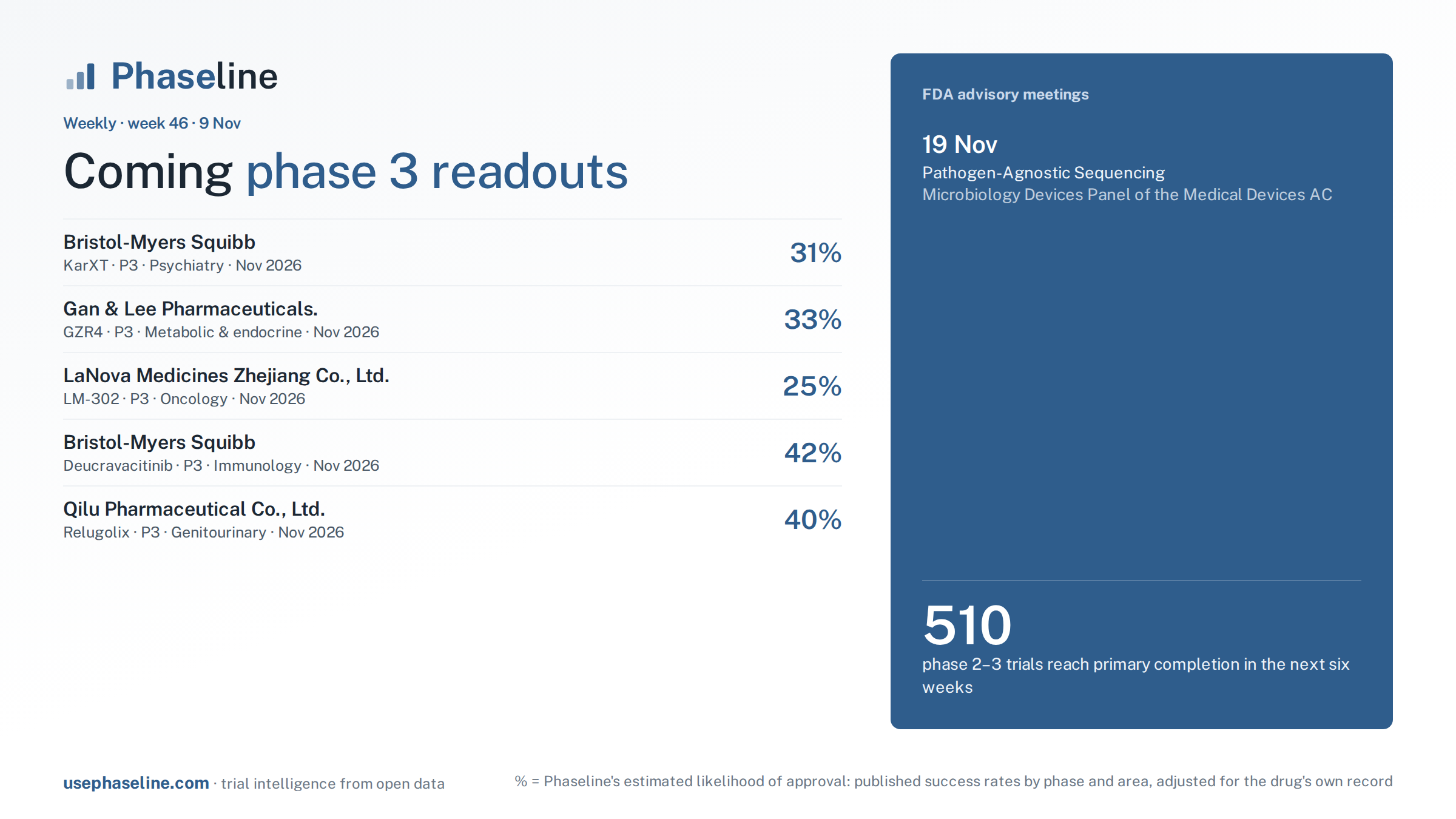
Phaseline weekly
Every Monday: the coming phase 3 readouts, FDA advisory meetings, timelines that slipped, the research trend of the week, a research spotlight and The Perspective — this week's news set against medicine in 1847.
The road to an FDA approval, for a team where a few people do everything
Most of Phaseline's users are not regulatory specialists. This page sets out the US path from first-in-human to approval as the FDA itself describes it, with the five documents a small company meets first. Everything here is taken from FDA's own guidances and its CDER teaching case, which are public-domain US government works; the links go to FDA's pages, where the current version always lives. Guidances change, two of the five are drafts, so check the date before you rely on a number.
This is orientation, not regulatory advice. For a real programme, the FDA's review division answers questions in writing, and a regulatory consultant who has done it before is cheap compared with a refuse-to-file letter.
1 · The path, in five milestones
FDA's teaching case Drug Approval. Bringing a New Drug to the Market follows a fictional small company with one diabetes drug. Its consultant draws the whole path as a line with five milestones. The point of the case: it is long, but it is a logical path with clear milestones, and FDA will talk to you before each of them.
Before the IND
An IND is legally an exemption: an unapproved drug may not be shipped across state lines, and the IND lets you ship it to investigators. It covers four things, animal studies (pharmacology, safety pharmacology, ADME, short-term toxicity in two species, in-vitro genotoxicity), chemistry/manufacturing/controls, the clinical protocol with investigator qualifications, and usually the informed-consent form. Questions before you submit go to the review division as a pre-IND meeting, which many divisions answer in writing. An institutional review board reviews the same protocol and consent form independently of FDA.
Phase 1 to phase 3: the meetings that matter
Two meetings carry the programme. The end-of-phase 2A meeting, after the first exposure–response data, is about finding the dose. The end-of-phase 2 meeting, before phase 3 starts, is where FDA looks at whether the nonclinical package supports phase 3, the dose and how it was chosen, the primary efficacy endpoint, trial design and population (including diversity and paediatric needs), and whether CMC is ready for phase 3. The meeting package goes in about a month before; without it the meeting may be cancelled. Within 60 days of this meeting the paediatric study plan is due. A special protocol assessment can make the agreed phase 3 protocol binding, but is usually unnecessary where the division's expectations are already clear from guidances and the labels of approved products.
The NDA review
The application is a story: is the drug safe and effective for the proposed use, do the benefits outweigh the risks, is the proposed label right, and is the manufacturing adequate to keep identity, strength, quality and purity. Within the review there are fixed touchpoints, a mid-cycle communication (by month 5 for a standard review, month 3 for priority), a late-cycle meeting about three months before the goal date, label negotiation in the second half, and inspections of clinical sites and manufacturing facilities. An advisory committee is convened when something needs outside opinion, typically a safety signal or a first-in-class question; FDA, not the committee, decides. User fees apply, with a waiver for a small business submitting its first human drug application – worth knowing before you budget.
FDA / CDER, Drug Approval. Bringing a New Drug to the Market, a fictionalised teaching case (information current as of September 2015; fee amounts and PDUFA cycle updated 2022). Read it in an afternoon: it is written for exactly the situation of a small company meeting FDA for the first time.
2 · Meeting FDA: the types, the clocks, the package
Formal meetings are classified by urgency, and each class has a clock FDA aims to keep. The table is from the 2017 draft guidance in use for years; a September 2023 draft keeps these and adds two more, noted below.
| Type | What it is for | FDA answers the request | Meeting held (or written reply) | Your package is due |
|---|---|---|---|---|
| A | A stalled programme or an important safety issue: clinical hold responses, dispute resolution, a refuse-to-file letter within 30 days | 14 days | 30 days | with the request |
| B | Pre-IND, pre-NDA/BLA, post-action after a complete response, REMS and postmarketing discussions outside a review | 21 days | 60 days | 30 days before |
| B (EOP) | End-of-phase 2 / pre-phase 3; certain end-of-phase 1 meetings | 14 days | 70 days | 50 days before |
| C | Anything else about development and review, including early consultation on a new surrogate endpoint | 21 days | 75 days | 47 days before |
Days are calendar days from FDA's receipt of the request. Three formats exist, face to face, teleconference or video, and written response only, which FDA prefers for pre-IND and most Type C questions and which is often the fastest way to a clear answer. FDA will not normally grant more than one of each Type B meeting per programme, so the questions have to be the right ones: the package carries the data, the specific questions, and your own proposed answers.
FDA, Formal Meetings Between the FDA and Sponsors or Applicants of PDUFA Products, draft guidance, December 2017, superseded in draft by the September 2023 version. Both are drafts: the numbers come from the PDUFA commitment letters, which is why they are stable.
3 · What counts as evidence of effectiveness
The law asks for substantial evidence from adequate and well-controlled investigations. FDA's long-standing reading is that this usually means more than one such trial, because a single result can be the product of an undetected bias, of chance (at the conventional significance level, one in forty trials of an ineffective drug will "work"), of something peculiar to one site or investigator, or, rarely, of fraud. Independent substantiation protects against all four. It does not have to be a copy of the first trial: a second study of different design, population or endpoint can be more convincing than a repeat.
When one trial can be enough
The 1998 guidance lists when FDA will consider a single trial sufficient. Reliance on one study is generally limited to a clinically meaningful effect on mortality, irreversible morbidity or prevention of a serious disease, where repeating the trial would be unethical or impractical. The characteristics that make a single study persuasive: a large multicentre trial where no single site drives the result; consistency across patient subsets; multiple studies within one (factorial designs); multiple endpoints involving different events; a statistically very persuasive result; and no post-hoc changes to analysis, no baseline imbalance, no unblinding. A single trial plus strong pharmacological or mechanistic evidence (replacement therapy for a deficiency, vaccines with challenge data) can also suffice. Conversely, one positive trial among several failed ones is not persuasive unless the failures can be explained.
When no new efficacy trial is needed
Effectiveness can sometimes be extrapolated: to children where disease course and drug effect are similar to adults; to new strengths and formulations via bioequivalence; to modified-release forms via pharmacokinetics; to other doses and regimens where the exposure–response relationship is understood; and to related claims (another phase or stage of the disease, a closely related condition) with one new trial supported by the existing ones.
FDA, Providing Clinical Evidence of Effectiveness for Human Drug and Biological Products, guidance for industry, May 1998. Old, final, and still the reference FDA cites; a 2019 draft, Demonstrating Substantial Evidence of Effectiveness, expands on it without replacing it.
4 · Designing the study: ICH E8(R1)
E8(R1) is the ICH text FDA adopted in 2022 on how clinical studies should be planned and run. Its central idea is quality by design: decide at the planning stage which few things really determine whether the study answers its question, the critical-to-quality factors – and build the protocol, the monitoring and the data handling around them, rather than treating every item as equally important. The guidance asks for a culture where problems are raised openly, for protocols stripped of procedures that are not essential, for patients and other stakeholders to be consulted on design, and for the critical factors to be reviewed as the study runs.
It also sets out the types of study in a programme, human pharmacology, exploratory and confirmatory safety–efficacy studies, studies in special populations, and post-approval studies, and the conduct basics: protocol adherence, training, data management, limits on access to interim data, safety monitoring, withdrawal criteria and when an independent data monitoring committee is needed.
FDA / ICH, E8(R1) General Considerations for Clinical Studies, guidance for industry, April 2022, final. The companion E6(R3) on good clinical practice and E9 on statistics are the next two to read.
5 · The part small companies underestimate: CMC and packaging
Chemistry, manufacturing and controls appear at every milestone: the IND needs a description of the substance, how it is made, stability and impurity profiles; the end-of-phase 2 meeting checks whether CMC supports phase 3; the NDA lists every manufacturing, testing and packaging facility, contract sites included, each ready for a GMP inspection at submission. Outsourcing manufacturing does not outsource the responsibility.
The container closure system – vial, stopper, blister, inhaler, prefilled syringe, is part of that. FDA's August 2026 draft guidance replaces the 1999 text with a risk-based framework: the level of scrutiny follows the route of administration and the dosage form, highest for inhalation and injectable products, lowest for solid oral forms. For each system the application should cover its description, a suitability evaluation (protection of the product, compatibility, safety of the materials, extractables and leachables, and performance), quality control of incoming components, stability testing in the final container, and tests for shipping and handling. Where the container is also a device, as with an autoinjector, the Office of Combination Products is involved.
FDA, Container Closure Systems for Human Drugs and Biological Products, draft guidance, August 2026, open for comment; until finalised, the May 1999 guidance and its 2002 Q&A remain in force.
6 · Reading list, in the order you will need them
- Drug Approval. Bringing a New Drug to the Market (CDER case study)The whole path in 25 pages, with a reference list of the guidances for each step.
- Formal Meetings Between the FDA and Sponsors or Applicants of PDUFA Products (draft, 2023)Before your first pre-IND request.
- E8(R1) General Considerations for Clinical Studies (final, 2022)Before writing the phase 2 protocol.
- Providing Clinical Evidence of Effectiveness (final, 1998)Before the end-of-phase 2 meeting: how many pivotal trials, and what makes one enough.
- Container Closure Systems for Human Drugs and Biological Products (draft, 2026)Before you lock the commercial presentation.
All FDA guidances are listed and searchable at fda.gov/regulatory-information/search-fda-guidance-documents. "Contains nonbinding recommendations" on the cover means what it says: a guidance is FDA's current thinking, and another approach can be discussed with the division.
7 · Three more that come up in every programme
M3(R2): when the animal studies have to be done
M3(R2) is the ICH schedule for nonclinical studies against the clinical programme. Before first-in-human: the safety-pharmacology core battery (cardiovascular, central nervous system, respiratory), pharmacokinetics and toxicokinetics in the animal species used, genotoxicity, and repeat-dose toxicity in two species whose duration supports the planned dosing, two weeks of animal dosing supports up to two weeks in people, and so on up to the six-month rodent and nine-month non-rodent studies that support chronic use. Reproductive-toxicity studies gate the inclusion of women of childbearing potential; carcinogenicity studies are generally needed only for the marketing application. The guidance also describes exploratory clinical studies (microdosing and other sub-therapeutic designs) with a reduced nonclinical package, which can be a cheap way for a small company to choose between candidates.
E6(R3): good clinical practice, rewritten
E6(R3), adopted by ICH in January 2025 and issued by FDA as guidance, replaces the 2016 text with a principles-based one. It keeps the responsibilities of sponsor, investigator, IRB and monitor, but asks for a risk-proportionate approach: quality by design (the same critical-to-quality idea as E8(R1)), monitoring and oversight focused on what matters to participant safety and data reliability, explicit data-governance expectations for electronic systems, and room for decentralised elements such as remote visits and direct data capture. For a small sponsor relying on a CRO, the sponsor-oversight sections are the ones to read: the work can be delegated, the responsibility cannot.
E9 and E9(R1): the statistics the reviewers will check
E9 (1998) is the statistical backbone of a confirmatory trial: pre-specified primary analysis, randomisation and blinding, the intention-to-treat principle, control of multiplicity, sample-size justification, and interim analyses run through an independent data monitoring committee. The 2019 addendum E9(R1) adds the estimand framework: before the trial starts, state precisely what is being estimated, the treatment, the population, the variable, how intercurrent events (treatment discontinuation, rescue medication, death) are handled, and the population-level summary, and then choose the analysis to match, with sensitivity analyses for the assumptions. FDA and EMA reviewers now expect an estimand section in the protocol; getting it right at the end-of-phase 2 meeting avoids the post-hoc analysis changes that the effectiveness guidance warns against.
ICH, M3(R2) Nonclinical Safety Studies (2009) · ICH, E6(R3) Good Clinical Practice (2025), E9 Statistical Principles for Clinical Trials (1998) and E9(R1) Addendum on Estimands and Sensitivity Analysis (2019). FDA issues each as a guidance for industry, found through the guidance search.
8 · When FDA says no: the complete response letters
A complete response letter is FDA's decision not to approve an application as submitted, with the deficiencies the company must address. Since July 2025 FDA publishes them. Phaseline reads each letter for the kinds of deficiency raised and checks Drugs@FDA for a later approval; the letters, their patterns and the companies' stated PDUFA dates are in the Investors view.
For the European route, including what carries over, see EU regulatory path.
Where Phaseline fits on the path
- Before the end-of-phase 2 meeting – Competitors on the same target and the Industry landscape show the available therapies FDA will measure you against; the Design check shows how trials like the one you are planning ended.
- During phase 3 – the Readout calendar and the FDA advisory-committee dates put competitors' readouts next to your own timeline; the Watchlist reports their protocol changes week by week.
- Before the NDA – the Orange Book and Purple Book data on each drug card show the exclusivity and patent picture you will enter; Earlier results and conference abstracts for the class show what the advisory committee will have read.
The road to an EU marketing authorisation, for the same small team
The European route runs through the same science but a different machine: one regulation for clinical trials across all Member States, one agency (EMA) whose committee gives an opinion, and a European Commission decision that turns the opinion into an authorisation valid in every EU country. For a company of a few people the most useful fact is that EMA has an SME office and a fee scheme built for exactly that size of company. Everything below is drawn from EMA's and the Commission's own pages, linked in each section; EU pharmaceutical legislation is being revised, so check the current text before relying on a period or a number.
Orientation, not regulatory advice. EMA answers development questions through scientific advice; a national agency (in Sweden, Läkemedelsverket) answers questions on trials run there.
1 · First: register as an SME
A company established in the EEA with fewer than 250 staff and either turnover of at most €50 million or a balance sheet of at most €43 million (the Commission's SME definition) can apply to EMA's SME office for SME status. It costs nothing and unlocks the incentives: 90% off scientific advice (100% for designated orphan medicines), 90% off and deferral of pre-authorisation inspection fees, deferral of the marketing-authorisation fee until the outcome, with a conditional exemption if the application fails after EMA's scientific advice was followed, 100% off for orphan products, and free translation of the product information into all EU languages at first authorisation. The incentives end on the day of a merger, acquisition or out-licensing to a non-SME. Do this before the first scientific-advice request, not after.
EMA, Financial advantages of SME status, and the SME office's user guide linked from it.
2 · The path, in five milestones
Scientific advice and protocol assistance
Scientific advice is EMA's answer, through the CHMP on the recommendation of its Scientific Advice Working Party, to the questions you ask: which comparator, which endpoint, how large a trial, whether a single pivotal study could do, whether a conditional authorisation is realistic. You submit a briefing document with the questions and your own proposed answers; two SAWP coordinators assess it, a meeting is held if the SAWP wants one, patients are consulted, and the CHMP adopts the final letter. EMA does not pre-evaluate results or give a view on benefit–risk. Protocol assistance is the same procedure for designated orphan medicines, with extra questions on significant benefit. Advice can be run in parallel with FDA, and with the EU's HTA bodies as a joint scientific consultation, so that the evidence plan satisfies both the regulator and the payers, worth considering early for a small company that cannot afford a second trial later.
EMA, Scientific advice and protocol assistance, with the SAWP meeting dates and submission deadlines for the coming year.
The clinical trial: one application for all countries
Since 2023 every new trial in the EU/EEA is applied for in the Clinical Trials Information System (CTIS) under Regulation 536/2014. The sponsor names a reporting Member State, which leads the assessment of Part I – the protocol, investigator's brochure and product documentation common to all countries, while each concerned Member State assesses Part II, the national documents: patient information, consent, insurance, sites. Validation takes 10 days (25 if there are questions); Part I assessment 45 days, extendable by up to 31 for a request for information and by up to 50 more for advanced-therapy products; each country issues its decision within 5 days of the conclusion. Part II may follow Part I by up to two years. Deadlines are calendar days, run on the reporting state's holidays only, and CTIS sends no e-mail, someone has to look in the system.
EMA, Clinical trials in human medicines, and the national agency's guidance for your reporting Member State (the Norwegian agency's application page sets out the timelines plainly).
Designations that change the path
- Orphan designation – for a life-threatening or chronically debilitating condition affecting at most 5 in 10,000 people in the EU, where no satisfactory method exists or the medicine would be of significant benefit. It brings protocol assistance, fee reductions and ten years of market exclusivity after authorisation. Apply before the marketing application; designation is reviewed at authorisation.
- PRIME – EMA's scheme for medicines against an unmet need, entered on preliminary clinical proof of concept; SMEs and academia can enter earlier, on compelling non-clinical data plus first-in-human exposure and tolerability. A rapporteur is appointed about a month after entry, a kick-off meeting follows at three to four months, iterative advice runs through development, a submission-readiness meeting about a year before the application, and PRIME products can expect accelerated assessment.
- Paediatric investigation plan – every new medicine needs a PIP agreed by the Paediatric Committee (PDCO), or a waiver, before the marketing application is validated; the plan is normally submitted after the first human pharmacokinetic data. Completing it earns six months on the supplementary protection certificate.
Orphan designation · PRIME: priority medicines · Paediatric investigation plans, all EMA.
The marketing authorisation application
New active substances for cancer, diabetes, neurodegenerative, autoimmune and viral diseases, orphan medicines and biotechnology products must use the centralised procedure; most others may. EMA appoints a rapporteur and co-rapporteur from the CHMP and a PRAC rapporteur for the risk-management plan. The assessment clock runs 210 active days: a list of questions at day 120 and a clock stop, usually three months, for the answers; a list of outstanding issues at day 180 and a second stop of about a month; an oral explanation to the committee if either side asks for it; and the CHMP opinion by day 210. With the stops the whole assessment usually takes about a year. An applicant can ask for re-examination within 15 days of the opinion, and the re-examination takes up to 60 active days. The European Commission then issues the decision within 67 days of the opinion, and the public assessment report is published.
Three variants matter for a small company. Accelerated assessment cuts the clock to 150 days for medicines of major public-health interest. A conditional marketing authorisation can be granted on less complete data for a seriously debilitating or life-threatening disease with an unmet need, where the benefit of immediate availability outweighs the risk; it is valid a year at a time, renewable, with obligations to complete the studies, and converts to a standard authorisation when they are done. Authorisation under exceptional circumstances is for cases where comprehensive data can never be collected.
EMA, The evaluation of medicines, step-by-step · Accelerated assessment · Conditional marketing authorisation.
3 · After the opinion: the payers
An EU authorisation does not put a medicine on a formulary; each Member State decides on price and reimbursement. Under the HTA Regulation, from January 2025 new cancer medicines and advanced-therapy products get a joint clinical assessment at EU level, in parallel with the EMA evaluation; orphan medicines follow in 2028 and all centrally authorised medicines in 2030. The joint assessment judges relative effectiveness against the comparators the Member States ask for, which is why the joint scientific consultation during development exists. A small company should plan the comparator and the endpoint for the payers at the same time as for the regulator.
4 · US and EU side by side
| Step | United States | European Union |
|---|---|---|
| Early advice | Pre-IND meeting (Type B), often answered in writing; INTERACT for very early questions | Scientific advice through the SAWP; 90% fee reduction for SMEs; parallel advice with FDA and HTA bodies |
| Permission to start a trial | IND; FDA has 30 days to put the trial on hold | CTIS application; Part I assessed by the reporting Member State in 45 days plus extensions, Part II nationally |
| Milestone meetings | End-of-phase 2, pre-NDA (Type B, 60–70 days to the meeting) | Follow-up scientific advice; PRIME kick-off and submission-readiness meetings for eligible products |
| Rare disease | Orphan designation (fewer than 200,000 patients in the US); 7 years' exclusivity; user-fee waiver | Orphan designation (up to 5 in 10,000); 10 years' market exclusivity; protocol assistance, fee reductions |
| Children | Pediatric study plan within 60 days of the end-of-phase 2 meeting | Paediatric investigation plan agreed with PDCO before the application; six-month SPC extension |
| Application | NDA/BLA; 60-day filing decision; 10-month standard or 6-month priority review from filing | MAA; 210 active days with two clock stops to a CHMP opinion; 150 under accelerated assessment; EC decision within 67 days |
| Earlier access | Fast track, breakthrough therapy, accelerated approval, priority review | PRIME, accelerated assessment, conditional marketing authorisation, exceptional circumstances |
| Outside experts | Advisory committee, when FDA wants one | Scientific advisory groups and ad-hoc experts consulted by the CHMP; oral explanation |
| If it goes wrong | Complete response letter; resubmission starts a new cycle | Negative opinion; re-examination within 15 days, up to 60 days |
| Who pays after approval | Payers negotiate individually | National pricing and reimbursement; EU joint clinical assessment for oncology and ATMPs since 2025 |
Where Phaseline fits on the path
- Before scientific advice – Competitors on the same target and the Industry landscape show which comparators and endpoints the field is using; the Design check shows how trials of your size and design ended, which is what the SAWP will ask about.
- During the trial – the Readout calendar and the Watchlist follow competitors' readouts and protocol changes, including the trials that will be the comparators in a joint clinical assessment.
- Before the application – the exclusivity and patent picture on each drug card, and the Earlier results for the class, are the background the rapporteurs will have read.
A revision of the EU pharmaceutical legislation is under way; it is expected to change regulatory data protection and some incentive periods. The pages linked above are updated by EMA and the Commission as it is adopted.
Phaseline weekly
The coming phase 3 readouts, FDA advisory meetings, timelines that slipped, the research trend of the week, a research spotlight and The Perspective — this week's news set against medicine in 1847.
Industry Landscape
Who else is working on the same target or mechanism, how far they are, and when they read out, every active program in phases 1–4, from companies and, if you choose, universities and hospitals, grouped by molecular target, drug class, company, diagnosis (ICD-10) and institution, to see your competitors and find your potential partners, and a company report for any sponsor. Built for small teams where everyone does a bit of everything, no competitive-intelligence department needed.
Loading…
What is medical research busy with right now? For each therapeutic area, Phaseline reads PubMed every week and shows which topics are growing fastest, in plain words.
Loading…
Who ties up with whom
The licences, collaborations and acquisitions the landscape's companies have filed with the SEC in the last two years, as a network over time: which companies join up, on which targets, in which areas, and what the acquired look like against the licensed.
Loading…
What the specialists hold
The life-science funds that report their holdings to the SEC, crossed with Phaseline's landscape: which companies with active trials the specialists hold, what those companies have in common, which companies travel together in the same portfolios, and what each fund's biotech book looks like. Public filings, funds and companies only. Ownership is description, never a signal: it does not enter the approval likelihood.
Loading…
Where are the industry's trials run, and is Europe losing them?
The industry says Europe's share of commercial trials has halved in a decade. The registries can be asked the same question every week: of the company phase 2–3 trials that started each year, how many have a site in Europe, the United States or China, how many are run in one region only, and how that differs by therapeutic area, drug type and country. For investors, where the activity actually is; for everyone else, the claim against the record.
Loading…
Method and research views
Views that are interesting for how they are made rather than for a decision this week: bibliometric methods applied to the trial registries. In development; descriptive; none of it enters the approval likelihood.
Dormant targets
Targets that were quiet for years and are being revived, found with the delayed-recognition method from bibliometrics applied to trial starts, with a backtest.
Target map: fields of drug development
The trial network clustered with the Leiden algorithm, named with OpenAlex and CWTS fields, as a map of where drug development sits.
Universities and hospitals
Which institutions, worldwide, write the publications that belong to the trials, and how closely they work with the companies. Institution level only.
Toward the clinic
How old the basic research behind an area's trials is, and who did it: the trial reports' references walked two steps back in OpenAlex. Under each area in Research trends.
Burden of disease
EU deaths (Eurostat) and rare-disease prevalence (Orphanet) next to the trials in each area, for the policy reader.
NIH exposure
How much of the active trial landscape carries an NIH grant, by area, institute and grant mechanism, read against the FY 2026 budget proposal that would cut NIH by 39 percent and merge its institutes into eight.
Trial blazer
A way to find new paths: target and disease pairs that no company has tried, each with the finished trials that point there, and the clinic-tested molecules on the target that have gone quiet. A short list every month, kept so it can be checked against what happens next.
NIH exposure
The FY 2026 President's Budget proposes an NIH of $27.9 billion, 39 percent below 2025, with fewer grants in every mechanism and the 27 institutes merged into eight. This view shows which of the trials Phaseline follows carry an NIH grant today, and under which institutes and mechanisms, so that the proposal can be read against the registry. The figures describe the request; Congress sets the appropriation.
Loading…
North America, Europe and China, read the same way
Phase 2-3 drug trials since 2010, by region, in two senses that give different answers: where a trial runs, and where the company behind it has its home. The same measures for each, so the three can be set beside each other.
Loading…
Trial blazer
A way to find new paths.
Loading…
The shelf
A terminated trial says it stopped. Many programs never say anything: the last phase 2-3 trial is completed, no results are posted, nothing new is started, and the drug quietly leaves the annual report. This view lists them, from four public sources read together. Silence is not proof that a program is over, and it is not a judgement of the science; it is a list of where to ask.
Loading…
Who writes the trial literature?
The universities and hospitals, worldwide, on the publications that belong to Phaseline's trials: how many of those publications each appears on, for which trials, areas and sponsors, how often it holds the corresponding authorship, and how closely it works with the companies (publications with a company co-author; authorships that carry a company as well, the dual affiliations). Counted per institution from OpenAlex. No person level, by design: Phaseline is not a register for looking up researchers.
Loading…
Closing the women's health gap
For decades, women were left out of drug trials, and conditions that affect only women have received a sliver of research funding. Here are the active trials designed for women, and the companies, universities and hospitals running them.
Loading…
Help shape Phaseline
Your answers decide what gets built next. Every question is optional, and two minutes is plenty.
Contact
Questions, or a trial that looks mis-scored? Send a note.